Archive for the 'accountability' Category
October 11th, 2011 by JJW

Ever since I got a sneak peak at the evidence Chinese environmental groups recently leveled against Apple, I’ve been researching, gasping, and writing about some appalling practices and how to improve them. Not only does the production of personal electronics rank low on social and environmental impacts, but Apple’s practices put it at the bottom of a very gross barrel.
Since I’m trying to make things better rather than sink into misery, I thought it was time I update a little of the progress that’s been made since I wrote my “open letter to Apple.” (original version here, to ChinaDialogue version here).
Note: I have always been a big fan of Steve Jobs and feel saddened by his early demise. I note that it is important to grieve, but grief is not a reason to stop making progress on this very important issue. On the contrary, I think that Apple should work to improve the social and environmental impacts involved in manufacturing its products as a way to burnish and secure the legacy of its founder.
Apple Opens Up, But More Progress Needed
First, and most importantly, Apple apparently has broken its silence and agreed to speak with NGOs and other stakeholders about the alleged social and environmental issues at its suppliers in China. (See the ChinaDialogue article “Apple Breaks its Silence” by Xie Xiaoping).
This is positive–even amazing–news which shows, just maybe, that Apple’s sustainability team is waking up to the power of effective stakeholder engagement.
For a very informative look at how a big brand used stakeholder engagement to overcome major difficulties, read the MIT Sloan Review article “How Gap Inc. Engaged With its Stakeholders” by industry veteran Sean Ansett and colleagues.
Conclusions from “How Gap Inc. Engaged With its Stakeholders” that Apple might benefit from:
- Stakeholder engagement is not easy; the process is often expensive and slow.
- Identifying and prioritizing stakeholders can enable a company to focus on developing relationships with a few key stakeholder organizations.
- Over time, Gap’s stakeholder engagement strategy has improved perceptions of the company.
I hold my breath that Apple will increase sustainability information transparency. The company still seems to see its supply chain as a risk to its brand, rather than an opportunity to engage and bolster its brand, much less begin to lead the IT industry toward greater transparency and responsible management of manufacturing impacts.
Holding Tech Companies Accountable through Stronger International NGO and Media Action
Secondly, I take issue with how the press characterized the August 31, 2011 revelation in the IPEA report “The Other Side of Apple (II): Pollution Spreads Through Apple’s Supply Chain” story as simply about how Chinese environmental groups were accusing Apple of misdeeds, rather than investigating the claims themselves. I am glad the story made headlines, but not investigating further seems like bad journalism.
On a larger and wider note, the press has almost universally failed to address the more systematic concerns the report brought up, like whether Apple should be exempt from taking responsibility for the ways in which its products are made. Some stories are exceptions, which I note below.
I guess I should be happy that the story got headlines in almost every major newspaper. I just hope the issues do not get swept aside. Now that the world is over the shock of the loss of Steve Jobs, how long before the admiration Apple fans have gets wedded to a serious movement to hold technology companies to account?
As he told TechCrunch, Monologist Mike Daisey characterizes Apple’s current manufacturing processes as Apple’s “terrible sin.”
He also points the finger at himself and everyone listening to say it’s “irresponsible for us not to consider” these issues. I completely agree with him. In fact, Daisey has become one of my favorite public figures, not just for his consciousness-raising work on Apple (I have yet to see, read or hear his latest work “the Agony and Ecstasy of Steve Jobs”), but because he is also so articulate, expressive, and expressive while also being very socially aware, and engaged enough to do something about his feelings.
Daisey rightly points out that “there are no nonprofits within the tech industry that are even concerned with these issues.” He adds, “There’s no one even petitioning these companies in the first world to have independent monitoring in the third world.”
Daisey states (incorrectly) that there is “nobody [monitoring] on the ground in China.” What I would say is that there are not as many people on the ground as there should be. There are a number of international voluntary standards and company codes of conduct that are dedicated to improving working conditions in China and around the world. His point, I think, is that Apple and other tech companies have chosen to spend more resources trying to prevent consumers and the public from seeing what is happening in factories than on improving conditions there. Such backward stances by these companies go against the historical currents of our times, which flow toward more transparency, not less, and hopefully, over time, lead to more sustainability outcomes that improve everyone’s circumstances. In an era of economic globalization, we need solutions like international voluntary sustainability standards adequately applied to lift everyone’s boats.

To illustrate just how silly it is to try to prevent supply chain transparency, even NGOs and consumers in China are starting to wake up to social and environmental issues. (See this story on Al-Jazeera, from which the picture above was taken).
This video of Mike Daisey is very eye-opening, entertaining, and visionary (sorry, the video doesn’t seem to be displaying, despite the embed, so click here to view the video, accompanying TechCrunch story, and other videos from the interview):
Other Stories about Apple
Thirdly, since writing the open letter to Apple, I have come upon many more resources and articles about Apple and I’d like to share them. A big thanks goes to folks like Rich Brubaker at CollectiveResponsibility/All Roads Lead to China/CEIBS and other comrades in the sustainability sector in China. I thank Rich, in particular, for introducing me to Mike Daisey’s work.
Here are some other stories about Apple and Jobs that I haven’t linked to elsewhere in this post:
The Human Side of Tech Manufacturing
Lastly, through reviewing this information, I have come to see more of the human side of global manufacturing. Yes, I’ve toured factories in China before, yes I’ve read statistics, written reports, interviewed manufacturing company presidents, attended stakeholder meetings of international labor standards like Social Accountability International (SA8000) in China, read Peter Hessler’s books, and so on, but I had never thought about workers in quite the same way as after seeing this brief documentary/video “Dreamwork China,” which interviews and photographs Foxconn workers:
Click on Dreamwork China to see more.
I look forward to watching how journalists, supply chain experts, responsible investment gurus, CSR managers, members of civil society, researchers, policy experts, and others respond to Apple’s invitation to help get its house in order. I hope these stakeholders work together to implement a long-term vision and spur Apple along the noble path, even if it strays.
July 10th, 2011 by JJW
Dear Apple:
That I am writing this letter is as unexpected as it is important. I abandoned most of my activist rhetoric in college, deciding to stake a career on working to cultivate enlightened corporate self-interest as the quickest way to a sustainable world. I usually work with and for corporations to help them be green, responsible, and competitive. So don’t take this letter as an attack from an environmental purist. I’ve seen a lot of bad things, but nothing quite like your case.
I’m writing this letter as a warning about the trouble you’ve gotten yourself into. Before my most recent trip to China, before I was shown the evidence soon to be released, I had assumed that you had your China supply chain under control, that the social unrest at the Foxconn factories would have woken you up to the importance of implementing strict social and environmental principles in factories that manufacture your magical products. I thought your passive attitude toward the sourcing of conflict minerals in your electronic circuitry was really just a cover while you flat-out hard pressed for an internal scramble to work with industry initiatives, government regulators, and suppliers to prevent guilt by association.
Instead, the evidence presented to me in Beijing last week of your mismanagement in China is shocking. The horrible pictures have not been released yet, or at least have not been tagged to you. I assume you know what I am talking about. Yet maybe I cannot assume this. You seem to have no idea of the storm your brand is about to get swept up in.
What is going on? What are you thinking? Do you simply not know? Did your subordinates fail to raise this huge risk to your attention? Do you assume that Chinese civil society is too weak to expose you, or that people are not going to care about hard-to-pronounce factory towns? Are you expecting to just hide this information?
You have time to make amends before your brand takes a beating the likes of which no company since Nike has so unconsciously brought upon itself. How you respond to the truth is going to sway a lot of your faithful, your bottom line, and your brand.
Here’s what you should do:
1) Take responsibility. Publicly. Now. Declare that you’re going to stop the pollution in your supplier factories. Then do whatever it takes to fulfill your promises.
2) Make your principles match your image. Make your manufacturing base as slick as your latest miracle products, your supplier factories’ discharge as clean as your website and stores.
3) Increase transparency. Open up your supply chain to NGOs, the media, and regulators. They’re not going to steal or sell your trade secrets. They’ll even help you regain public trust by being your eyes and ears to prevent future horrors. Make deals with these groups so they’ll go to you to find solutions before they go to the media.
4) Be a leader and transform the sector. Use third party verified standards or codes of conduct that will prove you’re doing a better job than your competitors so they need to follow your sustainability leadership. Donate money to NGOs so they can monitor your competitors too. Are you really so behind the times that you let PC manufacturers outshine you? That’s not cool. Not cool at all.
5) Measure results and communicate: Show progress in a measured way. Leading chemical companies manage their supply chain pollution better than you and show year-on-year improvements. You’ve gotten off easy because people do not easily associate your products with poisoning the earth, but that is changing.
6) Label your products as environmentally friendly. Use standards like EPEAT that measure a basket of social and environmental indicators and present that information at the point of sale with labels ranging from gold to silver to bronze. If you don’t take responsibility for this, others are going to force you into a corner.
7) Apologize. Nobody’s perfect, even a California tech god like yourselves.
8) Act quickly. One rotten apple…well, we really don’t want that to happen.
I hope this exercise hasn’t been too painful. I don’t mean to be harsh and I’ve tried to be constructive. The terms are really very simple. Be the kind of change your customers want you to be or they soon won’t be your customers, no matter how great the products.
The facts to speak for themselves. And believe me, these facts don’t speak in soft tones with automatic volume limiting technology. These facts scream sour.
Your stockholders and customers should be the most concerned. And nobody’s going to have to write a letter to them. If you don’t make cider of your falling fruit, your faithful just might start lobbing a few things your way.
Respectfully yours,
Joshua Wickerham
August 4th, 2010 by JJW
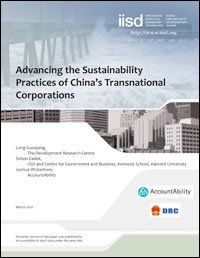 The International Institute for Sustainable Development (IISD) has published the final version of a paper I co-wrote with Simon Zadek and Long Guoqiang as part of a multi-year “sustainable trade strategy for China” with multiple stakeholders from China and abroad, supported by the Swiss SECO.
As IISD writes on its website,
“This paper examines how the Chinese business community can best use international sustainability standards to enhance its competitiveness in global markets, in so doing more effectively placing themselves on a sustainable economic path. We highlight the opportunity for Chinese businesses, supported by enabling public policies, to become a force in shaping the next generation of sustainability standards in global markets as a competitive strategy consistent with China’s broader interests. Doing this requires Chinese actors to engage more deeply in existing standards initiatives and take a more explicit role among the communities that have developed and now govern these standards. Effective engagement in such standards is a means of offsetting competitive disadvantages or creating competitive advantages when businesses and nations choose a more sustainable development path. This paper sets out both strategic options for businesses and policy options for the Chinese government to realize sustainable development and competitiveness goals.” —IISD Publications Centre
This is the final version of a paper launched a year earlier by AccountAbility, which I posted about here.
Download the final paper here.
June 5th, 2010 by JJW
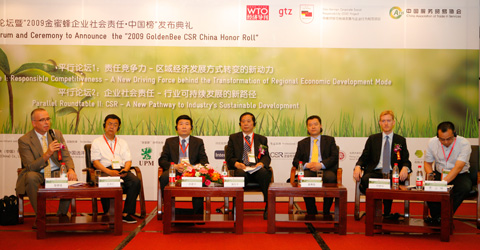
Fifth annual Golden Bee Conference: Regional Responsible Competitiveness Panel, image courtesy of WTO Tribune
Here is a summary of my remarks at the fifth annual Golden Bee conference in Beijing, speaking on a panel about how governments, companies, and civil society are working together to shift markets to reward responsible business action and make development more sustainable.
The session was chaired by the head of the Sino-German CSR Project, Rolf Dietmer, and had representatives from four provincial and district CSR initiatives, including Shandong, Shanghai Pudong, Jiangsu and Sichuan, plus a representative form China Unicom. My work with Chinese provincial economics planners has centered on the textiles and medicines sectors in Zhejiang through Responsible Competitiveness work with AccountAbility.
WTO Tribune wrote an article here (“Government duty-bound “responsibility”….in Chinese: ??“?”???) about the session here and captured some of my main points, but which I summarize here. (The entire transcript of my remarks in Chinese can be found here.
My main points:
1) Shifting markets to reward responsible business action requires a level playing field that no single sector (civil society, government, or business) can provide;
2) Chinese government officials at the provincial level are unsurpassed globally in their level of innovation and activity to promote new ways ;
3) Each provincial system is unique and there is need for coordination amongst local governments, the center and international stakeholders;
4) This unique approach to promoting sustainable development is both an asset and a liability, because if Chinese stakeholders do not coordinate properly, their market signals will be ignored by international buyers, ie, Chinese standards may not be recognized;
5) Chinese government officials, working with businesses, and using the power of the government bureaucracy, the media and civil society to promote good company practices and punish the bad, have the chance to clarify the way voluntary sustainability standards (such as the SA8000, GRI, ISO, AA1000, CSC9000T, FSC, etc) mature at the national and international levels;
6) Rather than create additional hoops for companies to jump through, governments can achieve economic, social environmental objectives by leveraging existing market mechanisms such as voluntary sustainability standards.
I add a point 7) International voluntary sustainability standards systems should see the power of Chinese stakeholders to pick winning standards as a wake-up call to be more serious about engaging in China and as an opportunity to scale up the impacts of their standards, since China plays such an integral part in so many global supply chains.
April 10th, 2010 by JJW
 This year’s survey and cover story on Chinese managers’ attitudes toward corporate social responsibility focuses on the role of consumers in driving sustainable consumption in China–and, increasingly, the world. Written by myself and AccountAbility’s Kate Ives, and Shi Yi.
This issue also has great inside shots of a BYD car factory floor.
Read the English version here and the Chinese version here.
Read the 2009 version and 2008 version.
December 25th, 2009 by JJW
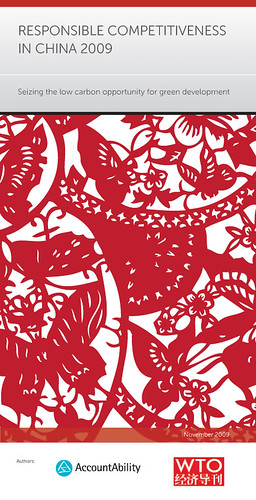
On November 30, I joined colleagues at the EU China Business Summit in Nanjing, Jiangsu, which dovetailed with the EU-China political meeting.
That day in Nanjing, under support from the Sino-Swedish Corporate Social Responsibility cooperation, AccountAbility launched the report Responsible Competitiveness in China 2009: Seizing the low carbon opportunity for green development.
This from AccountAbility:
Businesses in China are increasingly working with government and civil society to shift markets to reward sustainable development. These responsible business practices are becoming more and more embedded in the country’s emerging green industrial policy and low carbon development pathways. In some areas, China is set to leapfrog into the elite group of global green innovators.
These are some of the highlights from the report ‘Responsible Competitiveness in China 2009: Seizing the low carbon opportunity for green development’, launched at the 5th annual EU-China Business Summit as part of the Swedish EU presidency on 30 November in Nanjing, China.
The analysis presented in this report shows that China is developing a distinctive low carbon, responsible pathway, namely that:
- Low carbon industrial policies offer Chinese businesses and consumers huge opportunities
- Responsible business ventures in China are now impacting global markets relaunching China’s brand
- Strong government leadership, incentives and supportive policies are playing key roles
The report was independently researched and written in a unique collaboration between AccountAbility and the China WTO Tribune, with support from the Sino-Swedish CSR Cooperation Project. Learn more about the report’s key findings.
The Joint Statement of the 12th EU-China Summit specifically “decided to strengthen high-level dialogue and exchanges between think-tanks from both sides, and to promote and support regular exchanges.” Read the Joint Statement in full. AccountAbility’s partnership with the China WTO Tribune is an example of this kind of knowledge and collaboration exchange.

